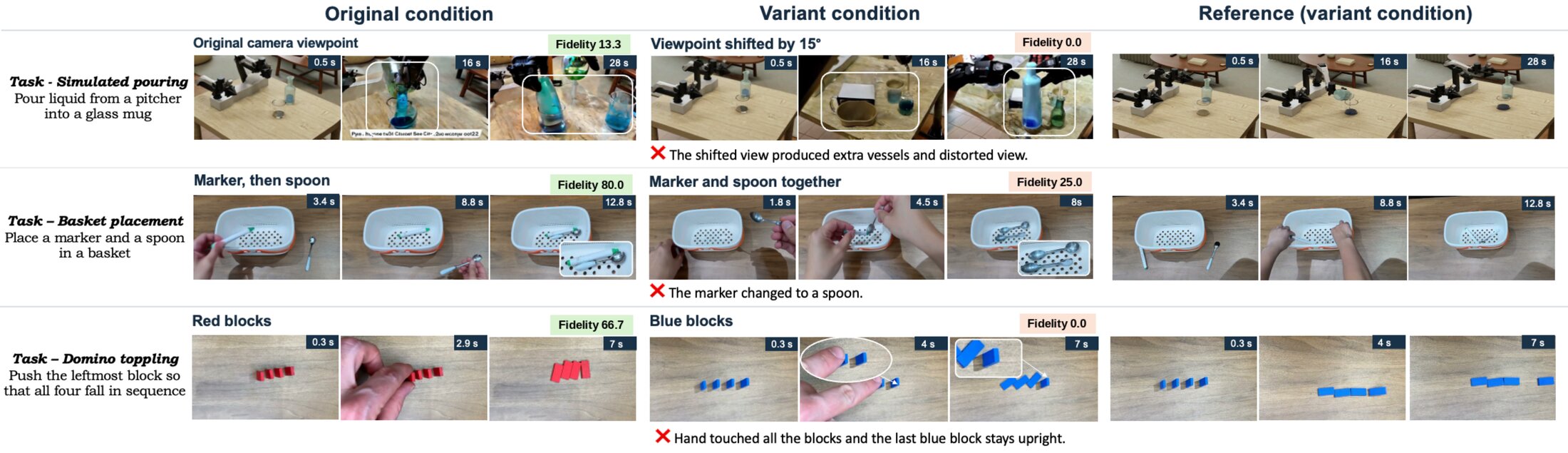
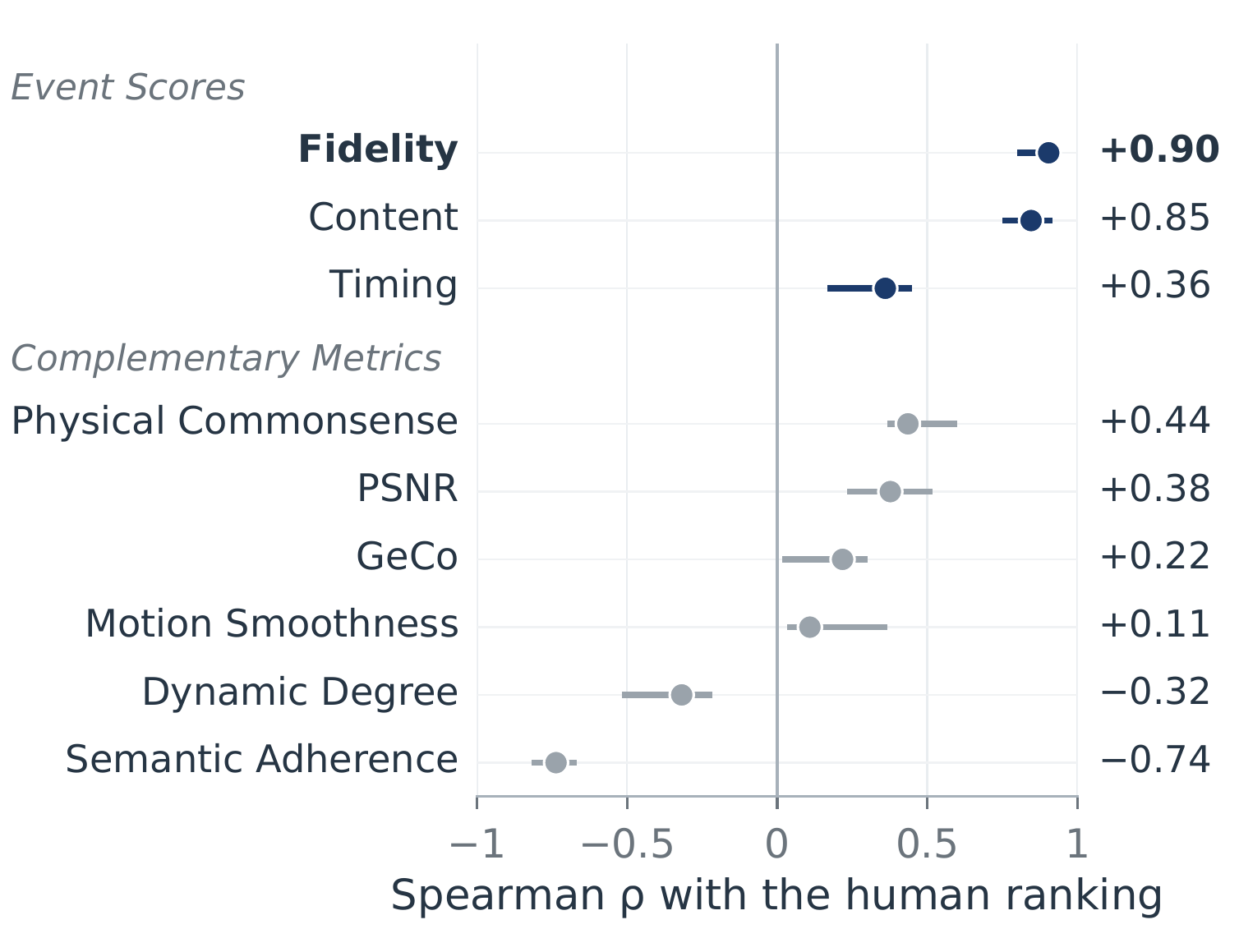
Edge cases are not the long tail; they are the norm. An embodied system deployed across changing environments, bodies, objects, and tasks will routinely encounter combinations that were absent from its training data. General-purpose physical intelligence therefore requires world models that reuse prior knowledge, predict consequences, and adapt with little or no additional training. Yet current evaluations of conditional video generation emphasize visual quality, prompt alignment, or isolated physical plausibility, leaving systematic generalization difficult to measure.
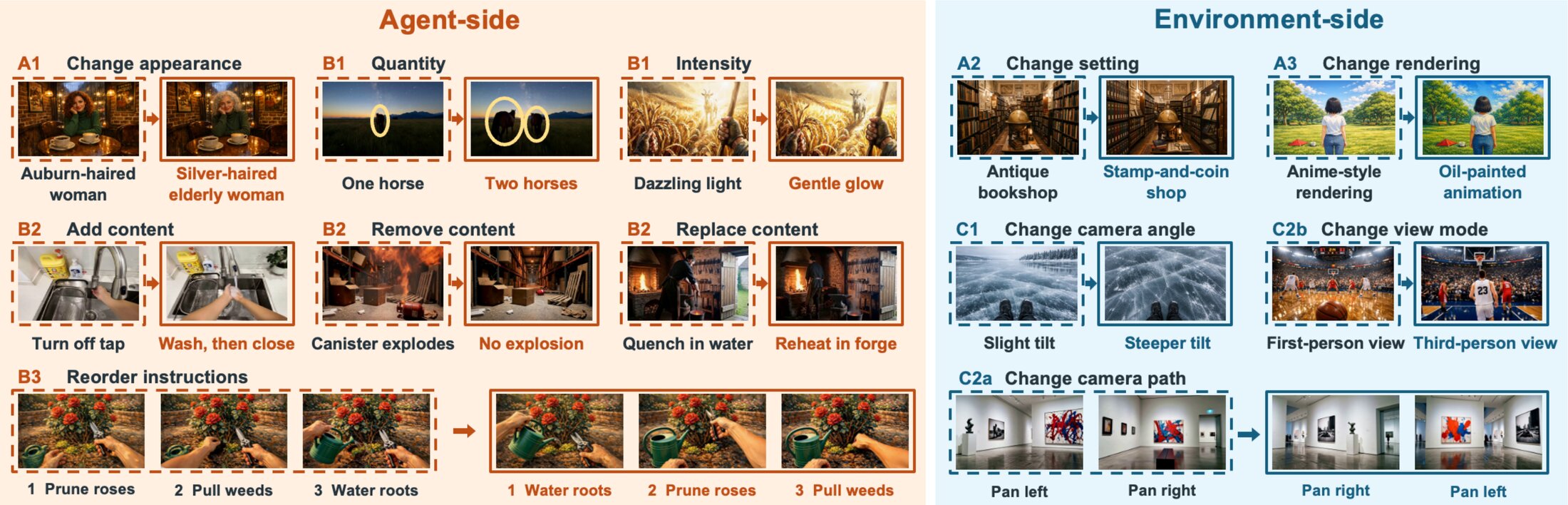
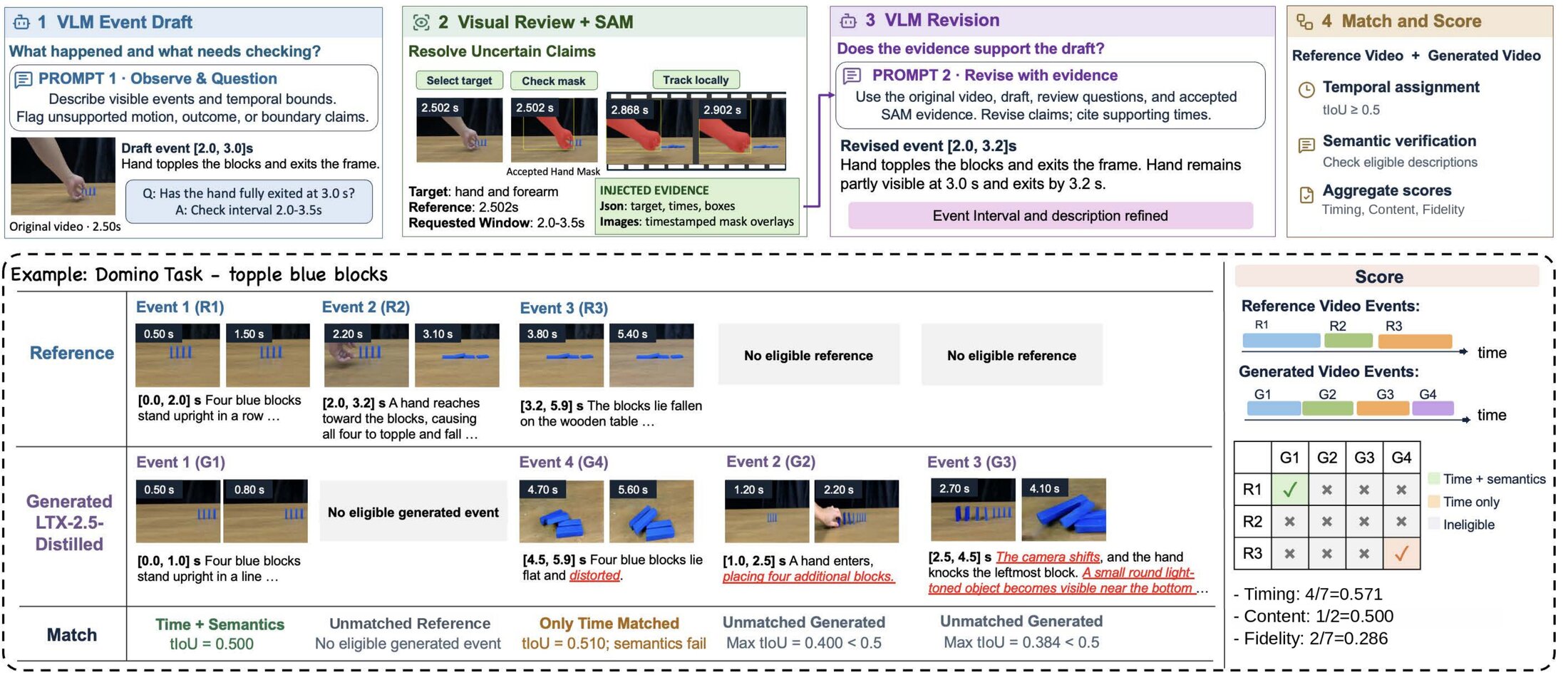
We introduce AxE Bench, a benchmark that organizes condition changes along eight factors of the acting agent and of its environment, and pairs every original condition with controlled variants that change one side or both. WBench-plus applies the same structure to an existing multi-turn benchmark, pairing each WBench scenario with variants on the environment side, through its world setting or camera behavior, or on the agent side, through its interaction instructions. To score generated futures, we develop an evaluation harness that combines vision-language reasoning with targeted computer-vision evidence, converting each video into temporally localized events and comparing generated events with reference events in both time and semantics.
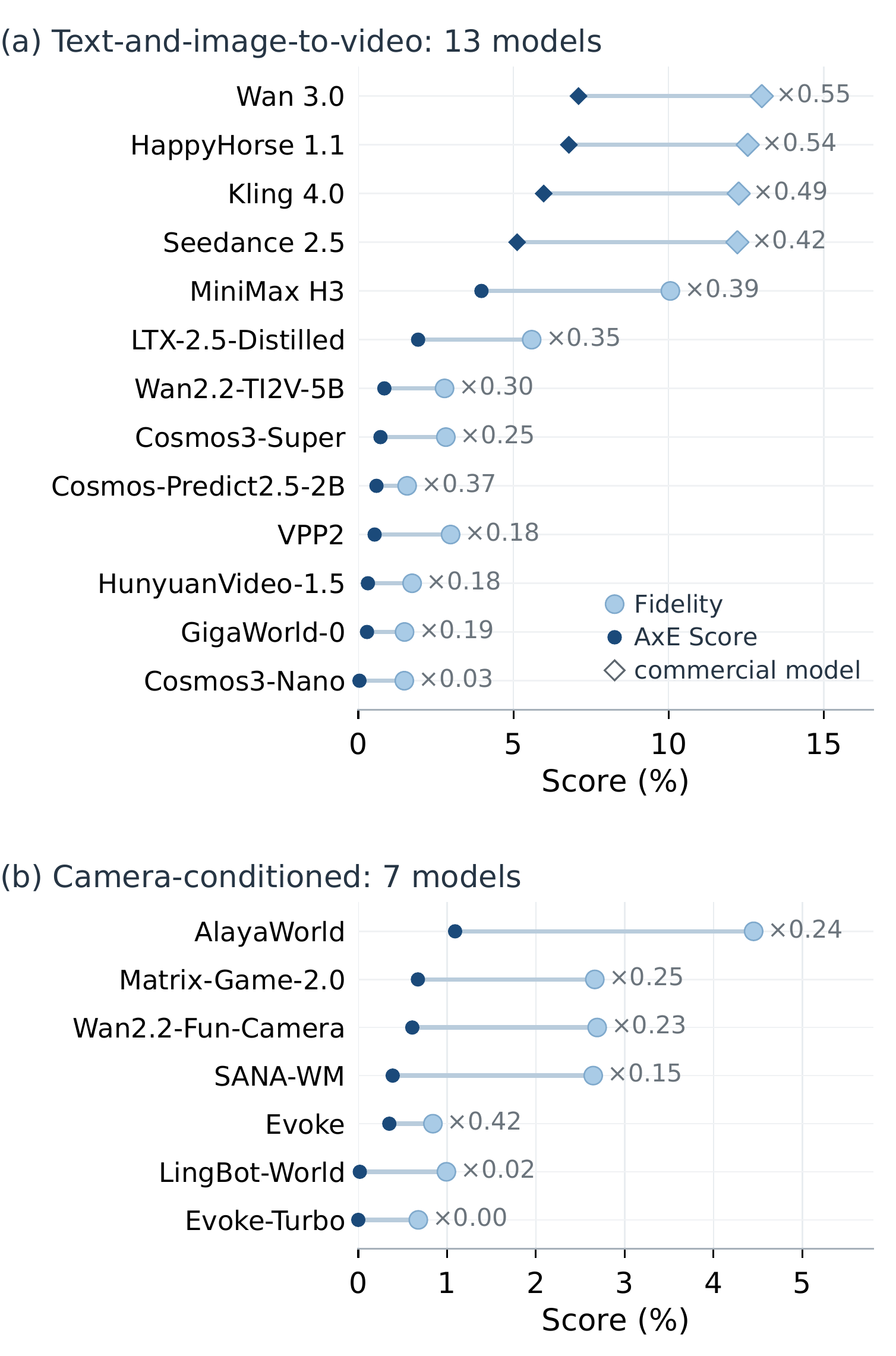
We summarize each model with the AxE Score, event Fidelity weighted by its Stability across original–variant pairs. Across twenty models, generated events match reference events far more often in timing than in content: no model exceeds a Fidelity of 13.01, the highest Stability is 0.55, and the highest AxE Score is 7.10. Together, these components turn world-model generalization from an informal aspiration into a falsifiable evaluation program for real and simulated interactions.
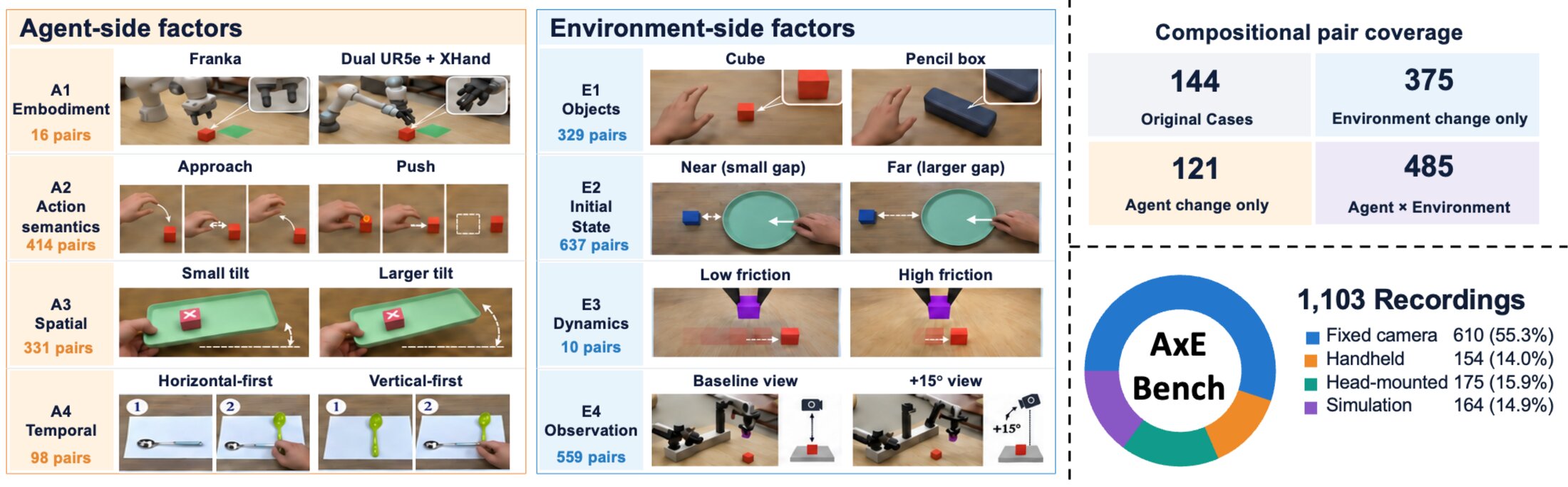
Every change is described relative to an original condition. Which side a variant changes defines four regimes: original, agent generalization, environment generalization, and agent–environment composition.
Agent-side factors
e.g. Franka vs. dual UR5e + XHand
e.g. approach vs. push
e.g. small tilt vs. larger tilt
e.g. horizontal-first vs. vertical-first
Environment-side factors
e.g. cube vs. pencil box
e.g. near vs. far gap
e.g. low vs. high friction
e.g. baseline view vs. +15° view


Each video becomes a list of timestamped events, checked against visual evidence, then matched to the reference events in both timing and content.
A vision-language model drafts events and flags claims that need checking.
Question-driven evidence: target selection, mask check, local tracking.
Events are revised using only the accepted evidence.
Generated events are matched to reference events in time and semantics.
Fidelity: how well generated events match the reference. Stability: how well that holds across original–variant pairs.

Event scores ×100 on the 1,103 recordings; Stability on the 981 pairs. Click a column header to sort.
| # | Model | AxE Score | Fidelity | Stability | Timing | Content |
|---|
Green marks the best value in each column within the group. For models with scores close to zero, Stability rests on few pairs. Complementary metrics (PSNR, motion smoothness, semantic adherence, physical commonsense, CamMC, dynamic degree, GeCo) are reported in the paper.
Event scores ×100 on the evaluated WBench-plus variants; Stability across Original–variant pairs. Click a column header to sort.
Evaluation scope: the full Plus set has 884 variants and 3,273 turns. The seven camera-conditioned models below were evaluated on 341 navigation-containing Plus cases, not on all 884 variants. LingBot-World and EchoWM Flash use only the supported navigation prefix; the other five camera-conditioned models execute all turns in their selected cases. Scores across different scopes should be interpreted with this coverage difference in mind.
| # | Model | AxE Score | Fidelity | Stability | Timing | Content |
|---|
Green marks the best value in each column within the group.
Fidelity, Timing, and Content are reported for both sets. The full Original set has 289 cases; camera-conditioned models use 158 supported Original cases alongside 341 Plus cases. These comparisons follow each model's supported instruction scope.
| Model | Original | Plus | ||||
|---|---|---|---|---|---|---|
| Fidelity | Timing | Content | Fidelity | Timing | Content | |
| Kling 4.0 | 26.33 | 41.96 | 62.31 | 27.80 | 41.81 | 65.89 |
| Seedance 2.5 | 26.22 | 42.99 | 60.75 | 27.02 | 44.02 | 60.91 |
| Wan 3.0 | 24.32 | 42.11 | 57.32 | 24.70 | 42.90 | 57.07 |
| HappyHorse 1.1 | 22.74 | 38.34 | 59.08 | 21.68 | 38.21 | 56.59 |
| Model | Original | Plus | ||||
|---|---|---|---|---|---|---|
| Fidelity | Timing | Content | Fidelity | Timing | Content | |
| MiniMax H3 | 19.48 | 45.67 | 42.48 | 17.55 | 43.22 | 40.32 |
| LTX-2.5-Distilled | 15.94 | 38.82 | 39.73 | 17.14 | 43.73 | 38.28 |
| Cosmos3-Super | 16.39 | 38.50 | 42.33 | 15.63 | 40.82 | 38.16 |
| GigaWorld-0 | 16.50 | 49.51 | 33.33 | 15.15 | 47.79 | 31.57 |
| HunyuanVideo-1.5 | 15.50 | 36.80 | 42.13 | 14.15 | 38.20 | 36.95 |
| VPP2 | 16.39 | 39.19 | 41.81 | 13.30 | 39.36 | 33.65 |
| Wan2.2-TI2V-5B | 10.07 | 42.42 | 22.37 | 7.38 | 42.92 | 16.37 |
| Cosmos3-Nano | 10.06 | 34.20 | 29.13 | 8.17 | 34.54 | 23.37 |
| Cosmos-Predict2.5-2B | 9.36 | 43.57 | 20.61 | 7.08 | 44.46 | 15.30 |
| EchoWM | 4.61 | 24.99 | 18.45 | 5.51 | 26.91 | 20.48 |
| Model | Original | Plus | ||||
|---|---|---|---|---|---|---|
| Fidelity | Timing | Content | Fidelity | Timing | Content | |
| Wan2.2-Fun-Camera | 28.42 | 50.88 | 55.86 | 34.35 | 59.41 | 57.57 |
| SANA-WM | 31.15 | 64.25 | 47.74 | 28.09 | 64.47 | 43.10 |
| EchoWM Flash | 26.41 | 39.72 | 66.50 | 26.77 | 42.57 | 62.44 |
| Matrix-Game-2.0 | 21.65 | 59.22 | 35.38 | 24.52 | 59.35 | 41.32 |
| LingBot-World | 20.09 | 41.52 | 47.95 | 21.44 | 43.25 | 49.59 |
| Evoke | 14.76 | 28.07 | 51.85 | 12.82 | 26.89 | 45.49 |
| Evoke-Turbo | 15.45 | 30.09 | 50.00 | 11.91 | 26.37 | 44.44 |
| AlayaWorld | 9.87 | 37.88 | 26.06 | 9.13 | 35.65 | 25.62 |
The detailed 25-metric Plus results (CSV) contain the three event scores, six VLM-judged WBench metrics and sixteen expert-model WBench metrics. A -- entry marks a metric outside that model's supported evaluation scope.
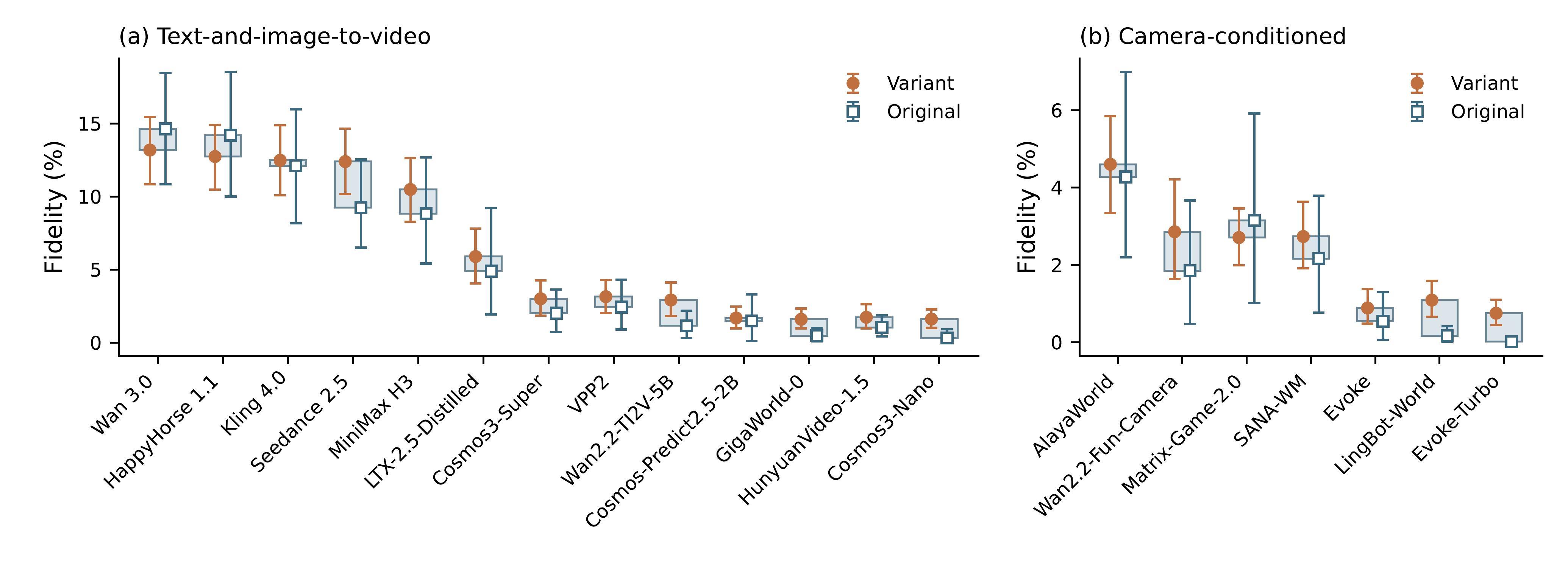
Generated events match reference events far more often in timing than in content. No model exceeds a Fidelity of 13.01.
Stability ranges from 0.39 to 0.55 for the five highest models. Wan 3.0 scores 7.10 on AxE against a Fidelity of 13.01.
Seedance 2.5 is within one Fidelity point of the other commercial models, yet has the largest original–variant gap of all twenty models. A small gap at a low score is not robustness either.
On WBench-plus the highest Stability is 0.67 among camera-conditioned models, 0.62 among commercial text-and-image-to-video models, and 0.53 among open text-and-image-to-video models.


@article{xu2027axe,
title = {AxE: Benchmarking Agent--Environment Generalization of Video World Models via Grounded Events},
author = {Xu, Haiyu and Chen, Yiyang and Zhou, Jiayi and Ji, Jiaming and Dai, Juntao and Yang, Yaodong and Chen, Boyuan},
journal = {arXiv preprint arXiv:2611.30120},
year = {2026}
}